Conversions
Convert between core hypergraph types by dropping direction, time, or layer information. Duplicate hyperedges are merged by summing weights. Edge metadata is merged by accumulating conflicting values into lists while preserving order.
Weighted by default: core classes are weighted by default; unweighted graphs must be created with weighted=False.
You will learn
Convert between hypergraph types while preserving weights and metadata.
Overview
Convert between hypergraph types while preserving weights and metadata.
Verify conversion outcomes with quick sanity checks and visuals.
Setup
[ ]:
import matplotlib as mpl

mpl.rcParams.update({
    "figure.figsize": (6, 4),
    "figure.dpi": 120,
    "savefig.dpi": 150,
})
[1]:
import hypergraphx as hgx
Directed to Hypergraph
Direction is dropped by merging sources and targets. If two directed edges map to the same undirected hyperedge, their weights are summed and metadata merged.
[2]:
dh = hgx.DirectedHypergraph(weighted=True)
dh.add_edge(((0, 1), (2,)), weight=2.0, metadata={"kind": "a"})
dh.add_edge(((2,), (0, 1)), weight=3.0, metadata={"kind": "b", "tag": 1})
hg = dh.to_hypergraph()
hg.get_edges(), hg.get_weight((0, 1, 2)), hg.get_edge_metadata((0, 1, 2))
[2]:
([(0, 1, 2)], 5.0, {'kind': ['a', 'b'], 'tag': 1})
Temporal to Hypergraph
Time is dropped. Multiple events of the same hyperedge across time are merged.
[3]:
th = hgx.TemporalHypergraph(weighted=True)
th.add_edge((0, 1), time=1, weight=1.0, metadata={"t": 1})
th.add_edge((0, 1), time=2, weight=2.0, metadata={"t": 2})
th.add_edge((1, 2), time=3, weight=3.0)
hg = th.to_hypergraph()
hg.get_edges(), hg.get_weight((0, 1)), hg.get_edge_metadata((0, 1))
[3]:
([(0, 1), (1, 2)], 3.0, {'t': [1, 2]})
Multiplex to Hypergraph
Layer is dropped. Edges across layers are merged by summing weights.
[4]:
mx = hgx.MultiplexHypergraph(weighted=True)
mx.add_edge((0, 1), layer="L1", weight=1.0, metadata={"layer": "L1"})
mx.add_edge((0, 1), layer="L2", weight=2.0, metadata={"layer": "L2"})
hg = mx.to_hypergraph()
hg.get_edges(), hg.get_weight((0, 1)), hg.get_edge_metadata((0, 1))
[4]:
([(0, 1)], 3.0, {'layer': ['L1', 'L2']})
Unweighted inputs become weighted counts
Unweighted temporal/multiplex inputs are converted to weighted hypergraphs where the weight equals the number of occurrences.
[5]:
th_u = hgx.TemporalHypergraph(weighted=False)
th_u.add_edge((0, 1), time=1)
th_u.add_edge((0, 1), time=2)
hg_u = th_u.to_hypergraph()
hg_u.is_weighted(), hg_u.get_weight((0, 1))
[5]:
(True, 2)
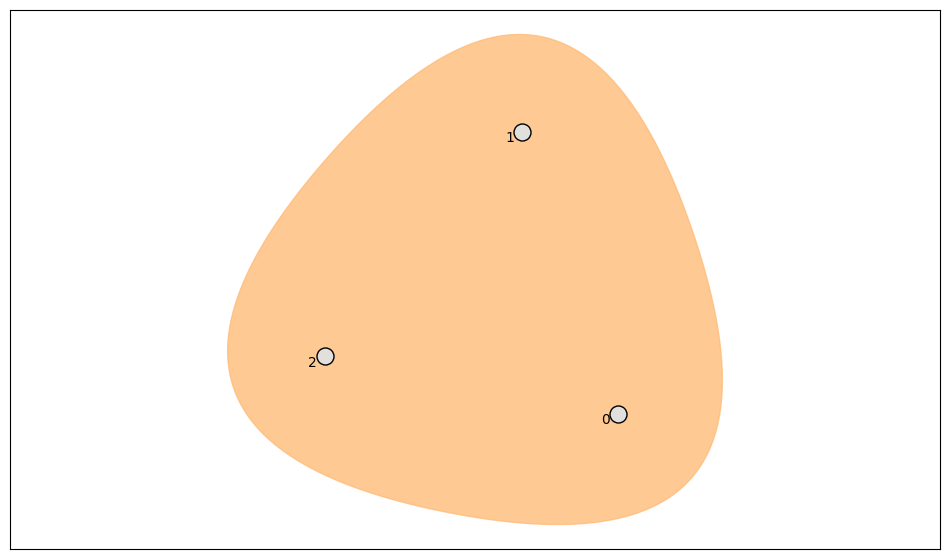
Quick visual sanity check
Visualize the converted hypergraph to confirm merged hyperedges.
[6]:
import matplotlib.pyplot as plt
from hypergraphx.viz.draw_hypergraph import draw_hypergraph

dh_viz = hgx.DirectedHypergraph(weighted=True)
dh_viz.add_edge(((0, 1), (2,)), weight=1.0)
dh_viz.add_edge(((2,), (0, 1)), weight=1.0)
hg_viz = dh_viz.to_hypergraph()

draw_hypergraph(hg_viz, with_node_labels=True)
plt.show()
Metadata control
You can drop node/edge/hypergraph metadata during conversion.
[7]:
mx2 = hgx.MultiplexHypergraph(weighted=True)
mx2.add_node(0, metadata={"role": "root"})
mx2.add_edge((0, 1), layer="L1", weight=1.0, metadata={"tag": "x"})
hg2 = mx2.to_hypergraph(keep_node_metadata=False, keep_edge_metadata=False, keep_hypergraph_metadata=False)
hg2.get_node_metadata(0), hg2.get_edge_metadata((0, 1)), hg2.get_hypergraph_metadata()
[7]:
({}, {}, {'weighted': True, 'type': 'Hypergraph'})